11 August, 2025
How to Register as Self-Employed in the UK: Step-by-Step Guide
Do you dream of ditching the traditional 9-to-5 and becoming your own boss? If so, maybe it’s time you thought about joining the UK’s 4.4 million self-employed workers.
Launching a successful small business isn’t easy, and it requires a significant investment of money, time and hard work to get right. Fortunately, getting yourself registered as self-employed is relatively straightforward. And with modern Hoxton Mix virtual office services, setting up and managing your business just got that bit easier.

In this guide, we’re going to take you through the whole process so you can get yourself registered for self-assessment with HMRC.
What you need to know before you sign up as self-employed
A self-employed person is anyone who earns an income through any independent economic activity and not by working for a company or another person (employer).
For the purposes of this guide, we’re going to explain how to register as a sole trader, but you can also form a limited company (Ltd.) on your own or as part of a partnership, in which the company is a separate legal entity from the company director(s). You can find out more about registering as self-employed versus a limited company here.
By contrast, a sole trader is a type of business structure where the person themselves is responsible for all aspects of the business, including its debts and liabilities, and it’s important to be aware of sole trader advantages and disadvantages before you get started.
The main appeal of becoming a sole trader is that it’s fast, easy and doesn’t cost you anything to get started. There’s also much less paperwork involved, while keeping accounts as a sole trader is usually much more straightforward too. For this reason, it’s often the best option for people when they first get started as self-employed.
The biggest disadvantage of registering as a sole trader is that you’re wholly liable for the business’s debts and, unlike with limited companies, your personal assets may be at risk if you get into financial difficulty.
You’re also unable to take advantage of the tax benefits available to company directors. As a sole trader, you’ll be paying marginal tax rates of 20% on profits above your personal allowance, 40% on profits over £50,270, and 45% on profits over £125,140. However, as a company director, you can choose to pay yourself a salary up to £12,570 (the current personal allowance), with anything above that in the form of company dividends. The tax bands on dividends are the same, but they’re charged at a lower rate. The basic rate for dividends is just 8.75%, while the higher rate is 33.75% and the additional rate is 39.35%.
When do I need to register as self-employed?
You’re considered self-employed as soon as you start earning money from your customers or clients, but you don’t have to register with HMRC straight away.
The deadline for registering for self-assessment is 5th October, following the completion of the tax year you started trading in. In the UK, the tax year runs from 6th April to 5th April.
For example, if you started working as self-employed in October 2024, you must register for self-assessment by 5th October 2025. Your first self-assessment tax return will then be due by 31st January 2026, which will be for all of the income you earned between starting work and 5th April 2025.
Note that you only need to register for self-assessment if you earned more than £1,000 in a single tax year.
For example, if you began working as self-employed in March 2025 and earned less than £1,000 before 5th April, you won’t need to register for self-assessment until 5th October 2026—assuming you earn more than £1,000 between 6th April 2025 and 5th April 2026.
This is one of the advantages of registering as a sole trader compared to establishing a limited company, as these must be registered with Companies House before you start trading.
How to register as self-employed in the UK
Registering as a sole trader with HMRC is simple, but that doesn’t mean it won’t seem a little daunting to people who are starting out as self-employed for the first time.
Fortunately, we love supporting entrepreneurs and small businesses here at Hoxton Mix, which is why we’ve put together this step-by-step guide that can take you through the entire process.
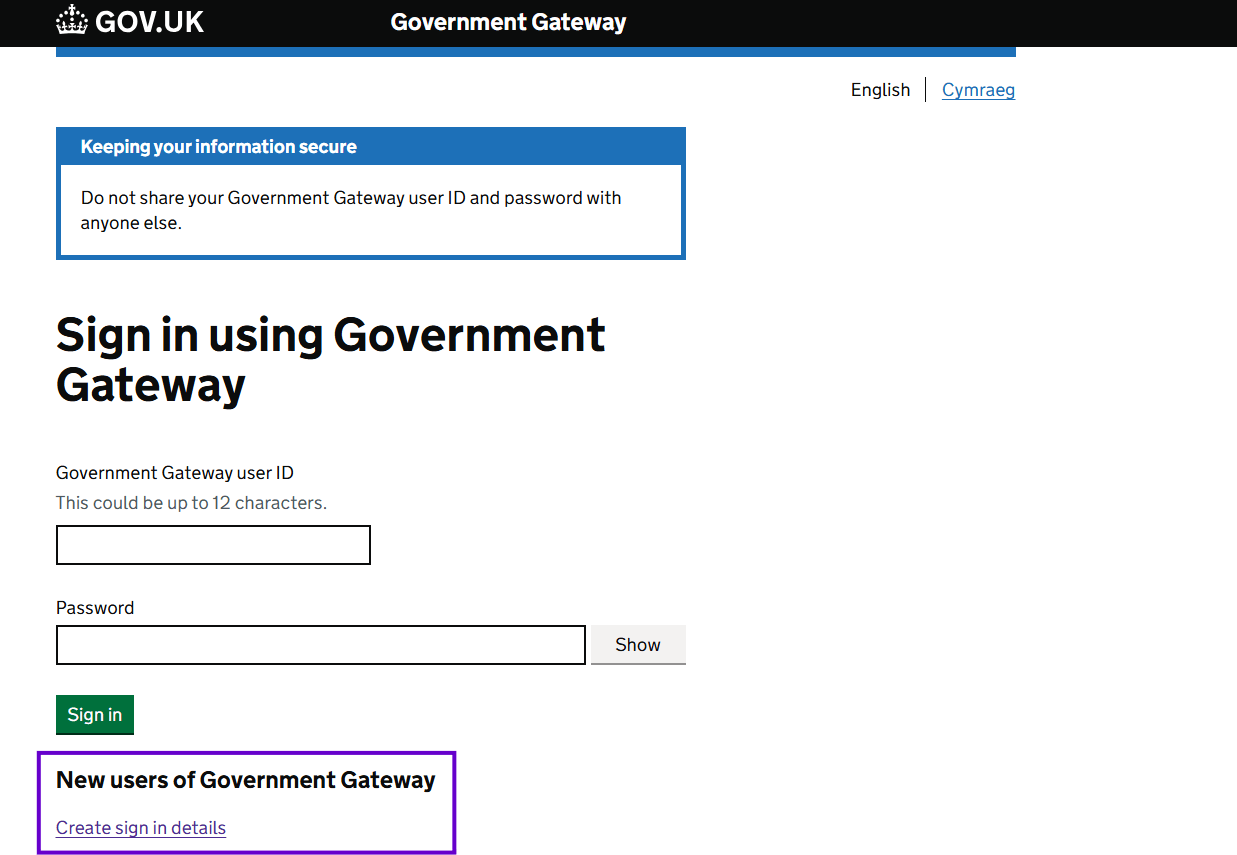
1. Sign up for a Government Gateway account
The first thing you need to do is create your Government Gateway account. This will be the portal you use to file self-assessment tax returns, pay your tax, and manage other HMRC-related activities.
To do so, you’ll need your National Insurance number or UK address, a recent payslip or P60, or a valid UK passport. These documents will be used to prove your identity later in the sign-up process.
You’ll also need to provide your email address, to which you will be sent a confirmation code.
N.B. As of July 2025, the UK government is rolling out a new login process named GOV.UK One Login, which allows users to sign in and prove their identity to access various government services using a single email address and password. Registering as self-employed is not currently included in One Login at the time of writing. You can view the full list of available services here. We will update this article (and others) when registering as self-employed via GOV.UK One Login is available.
2. Get your Government Gateway user ID
After you’ve completed the initial sign-up form, you’ll be presented with your Government Gateway user ID. You need this ID, as well as the password you chose during the sign-up process, every time you want to sign in to Government Gateway. Your ID will also be emailed to you, but we’d also recommend saving this ID separately to ensure you don’t lose it.
3. Choose the type of account you need
You’ll have three options for the type of account you want to create: Individual, Organisation and Agent.
If you’re registering as a sole trader, choose ‘Individual’, which includes creating a personal tax account and completing self-assessment. If you’re forming a limited company or partnership, select ‘Organisation’.
4. Apply for self-assessment
Next, you need to fill out an application in which you will have to indicate various personal information, including:
- Details of the work you are engaged in
- Your National Insurance Number
- The address from which you’ll be working (if you won’t be working at your home address).
You’ll also have the option to choose a business name and description, although you don’t have to provide a unique business name if you’re simply going to be trading under your own name.
5. Wait until HMRC reviews the application
Once your application has been reviewed and approved, you will receive a Unique Tax Reference number within ten days. The UTR contains ten characters; you will need to prove that you are self-employed and manage your taxes.
What Happens After I Declare as Self-Employed: Responsibilities
After registering as self-employed, you are obliged to:
- Keep accurate records of sales and expenses that relate to the business.
- File a self-assessment tax return before 31st January if you earned above £1,000 up to the previous 5th April
- Make ‘payments on account’ by 31st July, following the submission of your first tax return, if you will be required to file a tax return by the next 31st January. ‘Payments on account’ are advanced payments that go towards your total tax bill.
Remember that you’re also responsible for paying National Insurance Contributions, but that these will also be calculated as part of your self-assessment.
We also recommend keeping all correspondence from HMRC, as this will help you quickly and easily complete your tax return in the future.
How Long Does It Take to Register as Self-Employed?
There are a lot of things for you to think about when you first start out as self-employed, but fortunately, how long it takes to register as self-employed isn’t one of them.
Although you’ll have to spend a bit of time getting the key documents and information together (exactly how long this takes will depend on how organised you are), the application process itself should take less than an hour to complete.
Employing an accountant or bookkeeper to do this for you might not save you much time, as you’ll still have to provide them with all of the same information you’d need to give to HMRC, but it can at least give you confidence that the process has been completed correctly.
Once you’ve completed the application process, it’s over to HMRC to complete your registration as a sole trader. The official HMRC guidelines indicate that the full registration process takes at least seven days, while the average time for consideration of applications and the completion of registration takes from 7 to 10 days. The timeframe may increase if you are abroad (up to approximately 21 days).
How Can the Hoxton Mix Help?
When you register as self-employed, you’ll have to provide an address to HMRC. As a sole trader, this isn’t publicly available information, so there’s nothing stopping you from using your home address at this stage. However, you also need to be able to provide customers and suppliers with an address—and that’s when relying on your private residence becomes an issue.
This is where a virtual office address from Hoxton Mix can help, providing your new business with a professional address in a sought-after London location, while fully protecting the privacy of you and your family.
Establish your new virtual office at Paul Street, London, from just £19/month, including AI-powered mail handling, as well as mail scanning and forwarding to your inbox, and make going self-employed easier with a virtual office address for your business with plans starting from just 63p a day.
Have any questions? Contact us via live chat, call 020 3475 3374 or email help@hoxtonmix.com
FAQ
What if I’m already self-employed but not registered yet?
You should register as self-employed as soon as possible, but the deadline for registering for self-assessment is 5th October following the completion of your first tax year (5th April).
How long will it take for my application to be processed by HMRC?
It usually takes from 7 to 10 days, but there may be exceptions, for example, if you’re based outside of the UK.
What are the main self-employment opportunities?
The number of self-employed opportunities available to you are almost endless, but the most common careers pursued by sole traders include trainers and coaches, designers, photographers, drivers, content-makers and IT specialists.
Hand-picked related articles






London
Virtual Office
Mail Management