02 September, 2026
The Directors Privacy Report 2026
Starting a business takes courage and comes with plenty to think about; from choosing your company structure, to mapping out targets and knowing how you’re going to meet them through customer acquisition.
But, one thing many new business owners might not consider is how much personal information they are making publicly available during the process.
When registering a limited company through Companies House, Directors need to share specific information that becomes part of a public register. For founders working at home - who haven’t gone through this process before or aren’t using a virtual business address - this can mean they’re at risk of sharing their residential address.
To understand how widespread the issue could be, we analysed a sample of 5,000 British companies registered with Companies House, covering a total of 7,736 individual directors. With more than 5.4 million companies currently on the register, with an estimated 6 to 7 million directors, the study provides a snapshot of the potential scale of residential address exposure among UK business owners.
In the first-of-its-kind research, addresses were classed as residential based on wording and address patterns that suggest a home - for example, “12 Oak Close” or “Flat 4, 20 High Street”. This contrasts with commercial addresses containing terms such as “Business Centre” or “Office”. Full details of the classification and research methodology can be found below.
How many directors potentially listed their residential addresses in this research?
Here are the key findings from The Director’s Privacy Report 2026:
- Nearly 6 in 10 (58%) directors with classifiable addresses appear to use a residential address.
- Across the full sample, including addresses we were unable to classify, 47.2% of directors appear to have a residential address listed on Companies House.
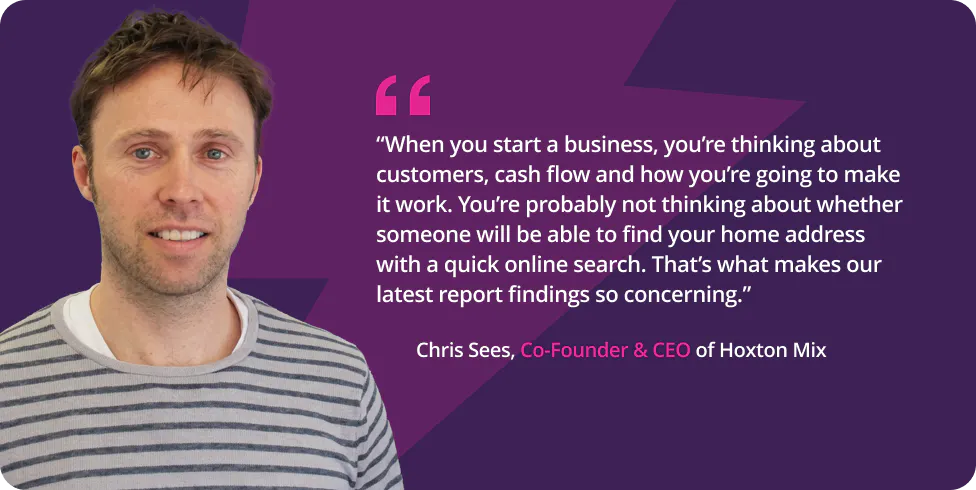
- Solo company directors are most likely to have a residential address exposed, with 61.5% classified as either residential or likely residential.
- Residential address use falls sharply among larger companies, with just 18.6% of directors at businesses with three or more directors classified as residential or likely residential.
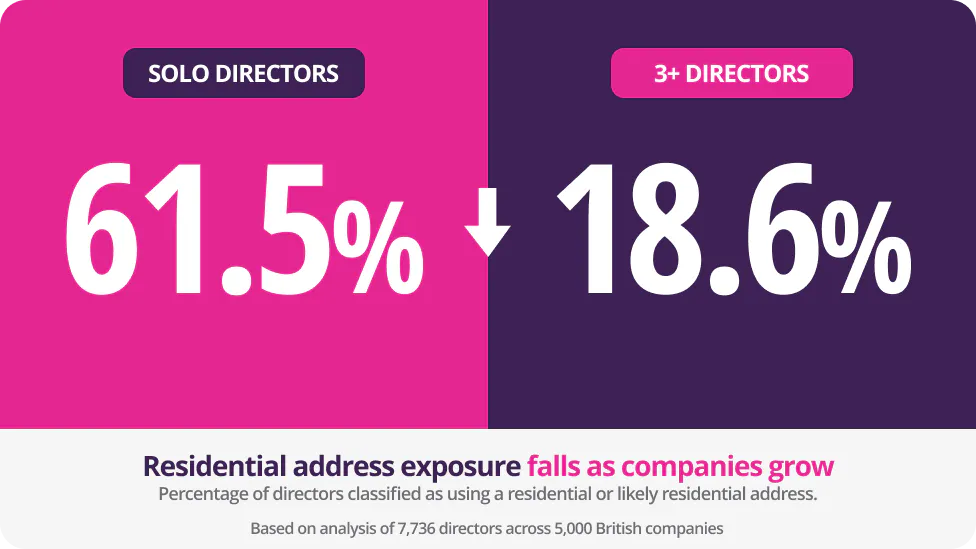
- Newer businesses are more likely to have directors using residential addresses, with more than half (53.5%) of companies aged 0–2 years falling into this category, compared with two fifths (41.1%) of companies aged 11+ years.
Thousands of directors are risking putting their home address on public records, exposing more personal information than they realise. How easy is this information to find, and what does it mean for privacy?
Read on to discover what our research reveals about the scale of directors’ address exposure in the UK.
Nearly 6 in 10 (58%) are risking exposing their residential address
The Directors Privacy Report 2026 reveals that of the 7,736 directors we analysed, 6,294 addresses could be confidently classified using specific terms. Of these, 3,648 were identified as residential or likely residential meaning that six in 10 (58%) appear to be using a residential address.
Looking at the entire sample – including addresses we couldn't classify – 47.2% of the 7,736 directors analysed used an address identified as residential or likely residential. If this rate were reflected across an estimated UK population of approximately 6.5 million company directors and people with significant control (PSCs) listed on Companies House, it would equate to around 3 million people potentially using a residential address.*
Which directors are most likely to reveal their home address on Companies House?
Solo company directors are most likely to list their residential address, with nearly two-thirds (61.5%) classified as either residential or likely residential. Residential address use falls sharply among larger companies, with nearly 1 in 5 (18.6%) directors at businesses with three or more directors classified as residential or likely residential.
New business owners are more likely to expose their home addresses
Our research suggests that newer businesses are more likely to have a residential address listed than more established companies. More than half (53.5%) of directors at companies aged between zero and two years appeared to use a residential address, compared with 41.1% of directors at companies aged 11 years or more.
Transport and logistics companies are most likely to use a residential address
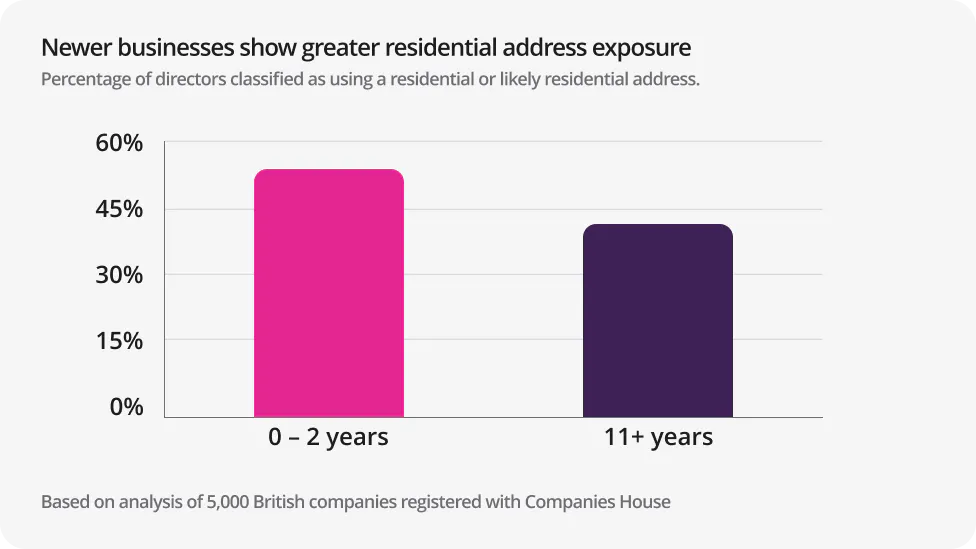
Transport & Logistics as an industry has the highest proportion of directors using residential or likely residential addresses at nearly 7 in 10 (69.3%), followed by Hospitality at 61.2% and the Motor Trade at 60.0%. Construction also lists a relatively high level of residential address use at 57.3%.
Director Privacy hotspots: Where in the UK are directors most likely to use their home address?
There was also a noticeable regional variation in residential address use. Directors in the East Midlands (55.5%) had the highest rate among the regions analysed, followed by Yorkshire (53%) while Wales (38.1%) had the lowest. Scotland and Northern Ireland have been excluded from the regional rankings due to insufficient sample sizes.
Here are the top five regions in the UK where directors are most likely to be exposing their home addresses:
| Region | % of Directors | # of Directors Analysis |
|---|---|---|
| East Midlands | 55.5 | 242 |
| Yorkshire | 53 | 280 |
| South East | 52.2 | 517 |
| West Midlands | 51.8 | 309 |
| North East | 50.7 | 108 |
Here are the regions in the UK where directors are least likely to be expose their home address:
| Region | % of Directors | # of Directors Analysis |
|---|---|---|
| Wales | 38.1 | 226 |
| South West | 41.7 | 618 |
| London | 44.9 | 2,313 |
| North West | 46.8 | 879 |
| East of England | 47.3 | 590 |
What are the risks when using your residential address?
Here are the risks if you use your home address either purposefully or accidentally:
- Your home is easier to find - If your residential address is publicly listed alongside your name and company, customers, suppliers and other members of the public may be able to connect your business identity directly to where you live.
- It can create a security and privacy risk - Making it easier to connect an individual's name, business and residential address can increase exposure to unwanted contact, harassment or other security concerns - particularly for founders with a high public profile or businesses dealing with dissatisfied customers.
- It can provide useful information to scammers - Publicly available information can be pieced together from multiple sources. Connecting a director's name, company details and potential home address could make targeted phishing, impersonation and social-engineering attempts more convincing.
- Your personal and professional lives become harder to separate - A dedicated business address creates a clearer boundary between home and work. This can be particularly valuable for solo founders and people running businesses from home.
Before registering a company or updating its details, check exactly which address will appear on the public Companies House register and consider whether you're comfortable with it being publicly searchable. Where appropriate, consider using a suitable business address rather than a residential address, ensuring it meets Companies House requirements and that you can reliably receive any official correspondence sent there.
How can you change the registered address of your limited company on Companies House?
The process for changing your limited company’s registered address is quite straightforward. Here’s how you can approach it:
- Go to the Companies House website under “Find and update company information” service.
- Sign in and search for your limited company.
- Choose “Change registered office address”.
- Enter the new address you’d like to use and submit the change but note, you will need your company authentication code for this.
- Companies House will update the register once the change has been accepted. They’ll also notify HMRC of the registered-office change
You need to notify Companies House within 14 days of the address changing, and the new address must be an appropriate address in the same UK jurisdiction in which the company is incorporated - e.g. an England & Wales company needs an address in England or Wales.
If the goal is to stop your home address appearing publicly, changing the registered address may not be enough so we recommend that you check your director profile too and if needed, look at changing your service address using the director-details (CH01) service.

Director privacy should be considered from day one
Starting a business inevitably means putting some information into the public domain, but our research suggests many directors could be sharing more than they realise. The takeaway is simple; your business can be public without your home having to be.
Just as choosing a company name, setting up a business bank account or registering a domain are part of getting a new venture off the ground, considering what personal information will become publicly searchable should be part of that process too.
Before registering a company - or if you already have one - take a few minutes to search your Companies House record as a member of the public would. Check what address is visible, understand what information you're sharing and, if you're not comfortable with it, explore the options available to create a clearer boundary between your business and your home.
Find out how Hoxton Mix can help you keep your personal and professional lives private by providing a virtual address, a business mail forwarding address in London or a WhatsApp Business number.
Methodology statement
The Founders Privacy Report 2026 analysed a random sample of 5,000 active UK companies registered with Companies House, covering 7,736 unique directors. The raw data file is available on request.
Publicly listed director service addresses were assessed using a consistent rule-based classification system, identifying wording and address patterns associated with residential and commercial properties. Addresses were classified as Residential, Likely Residential, Non-Residential or Unclear, with unclear addresses excluded from the headline 58% figure. Directors were deduplicated using their Companies House officer ID to avoid individuals being counted more than once.
The analysis uses publicly available Companies House data and identifies addresses that appear residential; it does not verify that an address is a director's personal home. Regional or sector findings with insufficient sample sizes were excluded from rankings.
*The estimated national figure is an indicative extrapolation. It applies the 47.2% rate observed across the full research sample to 6.5 million people, the midpoint of Companies House's estimate that 6–7 million individuals will require identity verification as company directors or people with significant control. The figure should therefore be treated as an estimate rather than an observed count.
Sources
Companies House (2025), Companies register activities: April 2024 to March 2025. View the Companies House report (Accessed: 19 August 2026).
Hand-picked related articles







London
Virtual Office
Mail Management